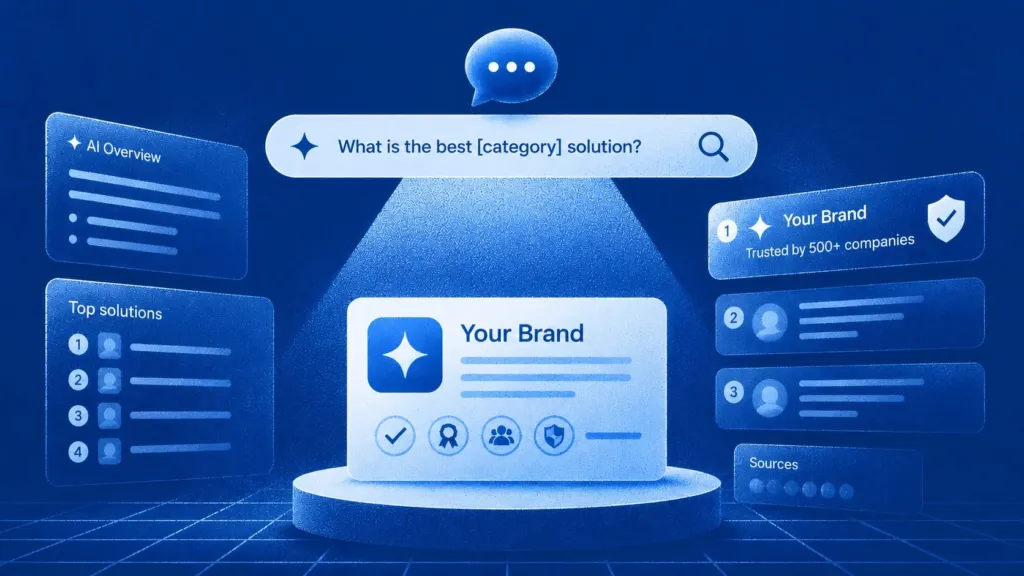
Before your buyer fills out a form. Before they open your homepage. Before a rep ever gets a reply — they asked ChatGPT, Perplexity, or Gemini what to buy.
Not “who makes this software.” What should I buy.
That’s not top-of-funnel anymore. That’s the whole funnel, compressed into one prompt. And most B2B SaaS companies aren’t in the answer.
The search bar didn’t disappear. It got a filter.
Buyers still research. They still compare. They still build a shortlist before anyone in sales knows they exist. What changed is who’s doing the researching for them.
AI engines read the category, synthesize the options, and hand the buyer a shortlist with a point of view already baked in. If your product isn’t part of that synthesis, you didn’t lose the deal. You never entered it.
This is the part most marketing teams miss: you can have the best SEO in the game and still be invisible here. Ranking #1 on Google doesn’t mean the AI cites you. Different game. Different rules.
AEO isn’t a rebrand of SEO. It’s a different question entirely.
SEO answers: what page deserves to rank for this keyword.
AEO answers: what source deserves to be trusted for this answer.
That’s a real distinction, not a marketing one. AI engines aren’t ranking pages — they’re deciding who to believe. They pull from sources that are clear, consistent, and corroborated. Not the loudest voice. The most citable one.
If your content reads like it was written to please a keyword, it won’t get picked. If it reads like it was written by someone who actually knows the answer, it will.
How AI engines actually decide who to cite
We’ve watched this closely enough to say it plainly:
1. Direct answers beat clever framing. AI models extract statements, not vibes. If your content buries the answer under three paragraphs of throat-clearing, it gets skipped for the competitor who just said the thing.
2. Consistency is a trust signal. If your site says one thing, your G2 listing says another, and a review site says a third — the model can’t confidently cite any of it. Fragmented facts don’t get quoted. They get averaged into mush, or ignored.
3. Third-party corroboration matters more than your own copy. AI weighs what other credible sources say about you almost as heavily as what you say about yourself. Reviews, comparison sites, analyst mentions, community threads — that’s where trust gets built, and where most SaaS marketing teams have zero presence.
4. Structure is not optional. Clear headers. Direct claims. Defined entities. Content that answers a specific question in a specific way, instead of a 2,000-word brand essay hoping something in there is quotable.
What this actually looks like in practice
Stop writing content that’s optimized to rank. Start writing content that’s built to be quoted.
- Answer the exact question your buyer is asking an AI, in the first two sentences — not the tenth paragraph.
- Say what your product does in the same words, everywhere: your site, your directory listings, your social bios, your sales collateral. One set of facts. Repeated everywhere. No creative variation on “what we do.”
- Get named in places you don’t control — comparison pages, review platforms, Reddit threads, analyst write-ups. That’s where AI is triangulating trust.
- Audit what AI engines currently say about you. Ask ChatGPT and Perplexity what your category leaders are and where you land. If you’re missing, or wrong, that’s your starting brief — not a guess.
The stakes are simple
If an AI engine can’t cite you clearly, it will cite someone else clearly. Your buyer won’t know the difference between “we didn’t show up” and “we’re not good enough.” They’ll just move on with whoever did show up.
This isn’t a future problem. It’s happening in your pipeline right now, quietly, in searches you’ll never see in your analytics. The only question is whether you’re building for it — or finding out about it in a lost deal review, three months too late.
Get in the answer. That’s the job now.