







— Pathloft
Share
We work with leadership teams to pressure-test growth strategies before misalignment shows up in pipeline, trust, or revenue.
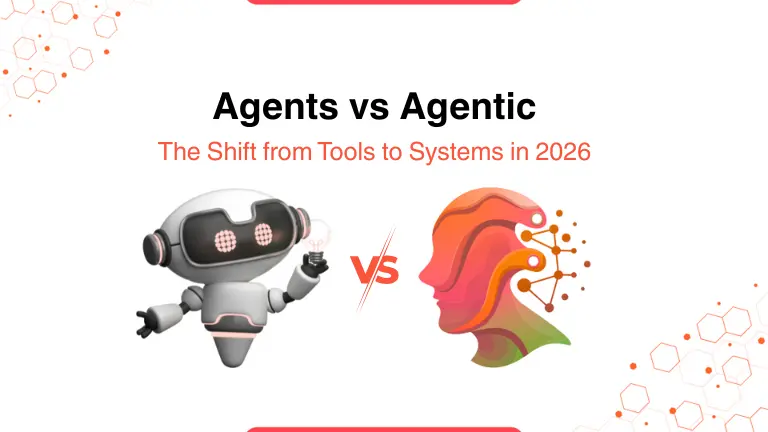
AI Agents vs Agentic AI
Most teams think they’re building AI capability.
What they’re actually building is a collection of tools that happen to talk to each other.
This distinction matters more than it sounds.
As AI adoption accelerates, a quiet divide is forming inside B2B organizations: teams investing in agents, and teams designing agentic systems. On the surface, both look similar. Under the hood, they produce very different outcomes.
By 2026, this gap will define who compounds leverage—and who keeps rebuilding the same demos.
An AI agent is a unit of execution.
It has:
A defined task
A prompt or instruction set
Limited autonomy
A clear start and end
In most discussions about AI agents in business, agents are treated as standalone solutions rather than components of a broader system.
In practice, agents are used to:
Write content
Enrich leads
Classify tickets
Trigger workflows
Summarize data
They are useful.
They are also bounded.
Most organizations stop here because agents feel tangible. You can deploy one, demo it, and show output in a leadership meeting. That visibility creates confidence—even when the underlying system hasn’t changed.
This is where most teams get it wrong.
Agentic systems are not about individual tasks.
They’re about behavior over time.
An agentic system:
Coordinates multiple agents
Maintains state and memory
Adapts based on outcomes
Optimizes toward a goal, not a task
Resolves conflicts between actions
The difference isn’t autonomy.
It’s governance.
Agentic systems don’t just act. They decide when, why, and in what sequence actions should happen.
That’s why they’re harder to build—and why most teams quietly avoid them. This is also where the idea of agentic systems explained tends to diverge from how they’re implemented in practice.
To make the distinction concrete, it helps to address the confusion around AI workflows vs agents, which is where many teams lose clarity early.
Single-purpose
Reactive
Stateless or lightly stateful
Easy to deploy
Easy to abandon
Rule-based
Predictable
Brittle under change
Efficient until reality shifts
Goal-oriented
Adaptive
Context-aware
Designed for uncertainty
Hard to demo, easy to scale
Most organizations believe they’re in the third category.
In reality, they’re running a fragile mix of the first two.
The failure doesn’t happen at launch.
It happens three months later.
This is usually the moment:
The pipeline review shows inconsistent results
Attribution becomes unclear
Outputs vary across teams
No one can explain which agent caused which outcome
Everyone agrees the system is “promising.”
No one wants to commit further.
In leadership meetings, this sounds reasonable at first.
“Let’s pilot a few agents and see.”
Three months later, the question isn’t whether AI works.
It’s why no one can explain what actually changed.
The cost shows up quietly.
Slower decisions. Longer approvals. More dashboards, less clarity.
By the time leadership asks whether AI “worked,” the cost has already been paid—in momentum.
Agents multiply surface area without reducing decision load.
Teams that try to scale by adding more agents usually end up slowing down—while telling themselves they’re innovating.
Agentic systems don’t start with agents.
They start with intent.
A genuinely agentic system has:
A clear objective hierarchy (what matters most)
Feedback loops (what worked, what didn’t)
Memory (what has already happened)
Constraints (what not to do)
Arbitration logic (what wins when goals conflict)
This is usually where the roadmap gets vague.
Not because teams lack tools.
Because clarity forces commitment.
The hardest question isn’t technical.
It’s political: who owns the decision when the system is wrong?
Until that’s answered, systems never become agentic. They just become more complex. This is no longer a tooling debate—it’s an enterprise AI strategy question.
This isn’t a tooling problem.
It’s a leadership one.
Agentic systems force teams to confront decisions they’ve been deferring:
Who owns outcomes versus execution
Which decisions can be delegated—and which cannot
Where judgment lives when automation fails
How progress is measured when outputs aren’t linear
This is usually the point where everyone nods.
And the roadmap quietly returns to “adding one more agent.”
By 2026, agents will be everywhere. Cheap. Fast. Interchangeable.
That’s not the advantage.
The advantage will belong to teams that:
Design systems, not stacks
Optimize decisions, not tasks
Treat AI as infrastructure, not labor
Build memory into growth, not just speed
By 2026, agentic AI systems will matter less for their novelty and more for how they shape enterprise decision-making.
More agents won’t save teams from complexity.
Agentic systems will.
AI agents are individual execution units designed to complete specific tasks, such as writing content, enriching leads, or summarizing data. They operate with limited context and autonomy.
Agentic systems are coordinated architectures that manage how multiple agents behave over time. They maintain memory, adapt based on outcomes, resolve conflicts between actions, and optimize toward overarching goals rather than isolated tasks.
No. Effective agentic systems are selectively autonomous.
They explicitly define which decisions can be automated, where human approval is required, and how escalation happens when outcomes deviate. Full autonomy is rarely the goal in B2B environments. Controlled autonomy is.
Most agent-based strategies fail because they increase execution without clarifying ownership.
As more agents are added, teams struggle to explain causality, accountability, and decision logic. This leads to leadership hesitation, stalled investment, and eventual rollback—often without clear lessons learned.
Yes, but only if they start with intent before tooling.
Small teams fail when they adopt agents first and attempt to design systems later. Successful teams define goals, constraints, and feedback loops upfront, then introduce agents as components—not the foundation.
No. Agentic systems surface human judgment rather than remove it.
They expose trade-offs, assumptions, and constraints faster. Teams with strong judgment scale better. Teams without it encounter failure sooner.
We’re the people at Pathloft who get called when growth “should be working” — but somehow isn’t.
We spend our days untangling messy funnels, questionable metrics, and strategies that looked great in slides but struggled in the real world. This blog is where we think out loud, test ideas, and share patterns we’re seeing across modern B2B growth teams.
No hype. No hacks. Just honest thinking from people who’ve sat in too many pipeline reviews to pretend everything is simple.
View all posts Pathloft helps growth leaders understand how buyers discover, evaluate, and trust brands in an AI-driven world—and design systems that compound long-term impact.
Smart marketing starts here, Proven growth plays that help you do your job — and do it better.
Actionable strategies, thought leadership, and updates from PATHLOFT— straight to your inbox.
By selecting “Accept All,” you consent to the use of cookies on your device to provide the best possible experience on our website.
To learn more about the cookies we use, please review our Privacy Policy.
Manage your cookie preferences below:
Essential cookies enable basic functions and are necessary for the proper function of the website.
You can find more information in our Privacy Policy.