ChatGPT recommends the B2B companies it can find, understand and verify. When it searches the web, it reads a handful of pages for the buyer’s exact question and names the companies those pages describe most clearly and most often. When it doesn’t search, it answers from training, which favors brands that were already talked about everywhere.
That’s the short version. The rest of this post is the operator version: where ChatGPT gets its information, why it keeps naming your competitor, what a 20 to 200 person firm can fix in 30 days, and how to check where you stand this week. It’s the same playbook we run in our AI Search & Discoverability work.
Why this is a pipeline problem, not a vanity metric. In G2’s April 2026 survey of 1,076 B2B software buyers, 51% said they now start research in an AI chatbot more often than in Google, up from 29% a year earlier. 85% think more highly of a vendor when a chatbot includes it in an answer, and 69% picked a different vendor than they planned because of a chatbot recommendation (G2, The Answer Economy). If you’re not in the answer, you’re often not on the shortlist.
What you’ll get from this guide:
- How ChatGPT decides, in plain terms, without the hype
- The six signals that separate the company it names from the one it skips
- Real patterns from 29 B2B homepages we audited in October 2026
- A 30-day fix plan and a 20-prompt test you can run yourself
Where does ChatGPT get its information about B2B companies?
ChatGPT works from two places: what it learned in training, and what it finds when it searches the web at the moment you ask. Which one it uses depends on the question. “What is a managed service provider” can come from memory. “Best managed IT provider for a 40-person law firm in Dallas” usually triggers a live search.
Training memory. Built months before you ask. Brands that show up a lot across the web (press, forums, reviews, lists) get remembered. A 30-person MSP rarely makes it in, which is why live search is where smaller B2B firms actually win.
Live search. OpenAI runs three separate bots, and mixing them up is one of the most common mistakes we see:
| Bot | What It Does | What Blocking It Means |
|---|---|---|
| OAI-SearchBot | Finds and indexes pages for ChatGPT search. | Your pages won't appear in ChatGPT search answers. |
| GPTBot | Collects content that may be used to train future models. | Opts you out of training only. ChatGPT search is unaffected. |
| ChatGPT-User | Opens a page when a user asks ChatGPT to visit it. | Requests are initiated by a person, so robots.txt may not apply. |
Source: OpenAI’s crawler documentation. OpenAI says robots.txt changes take about 24 hours to apply.
What it reads when it searches. For a B2B buying question, the pages it pulls usually come from six places:
- Your own website: service pages, case studies, pricing, FAQs
- “Best of” and comparison articles written by someone else
- Review platforms: G2, Capterra, Clutch, Google reviews
- Directories and partner listings, such as vendor partner pages for MSPs
- Forums and communities: Reddit, Spiceworks, niche Slack and LinkedIn groups
- Video transcripts and podcasts, YouTube in particular
Your own site matters more in ChatGPT than most people assume. Onely asked five AI engines 31 “best agencies for X” questions in October 2026. In ChatGPT, 57% of cited pages were the named brands’ own websites and 22% were lists. In Perplexity, Gemini and Google AI Mode, lists made up 59% to 77% of citations (Onely). Our read: your website decides how ChatGPT describes you, and third-party pages decide whether every other engine includes you at all. You need both.
How does ChatGPT choose between competing companies?
It picks the companies whose pages fit the question best and whose story checks out across several sources. There’s no ranking list and no paid slot. Across the client and prospect audits we’ve run, six signals explain almost every win and loss:
| Signal | What ChatGPT Is Looking For | What It Looks Like on a B2B Site |
|---|---|---|
| Fit to the Question | A match on size, industry, location, and use case. | "Managed IT for 20 to 150 person law firms in North Texas," not "IT solutions for businesses of all sizes." |
| Entity Clarity | Who you are, what you do, who it's for, and where you operate. | The first 50 words of your homepage say it plainly. The same description appears on LinkedIn, Clutch, G2, and your Google Business Profile. |
| Corroboration | Independent pages saying the same thing about you. | Reviews, a mention in a trade article, a spot on a comparison list, or a Reddit thread where a real customer names you. |
| Quotable Proof | Specifics it can repeat with confidence. | Named case studies with numbers, client logos with outcomes, response times, and certifications. |
| Depth on the Topic | Coverage of the whole problem, not one thin page. | A service page plus pricing factors, a comparison page, an FAQ, and two or three guides on the questions buyers ask. |
| Access | Pages it can actually read. | OAI-SearchBot is allowed, the firewall isn't blocking it, and core content is available in plain HTML rather than being loaded exclusively by heavy JavaScript. |
The research backs the proof signal. In a peer-reviewed study presented at KDD 2024, adding statistics, quotations and citations to a page raised its visibility in generative engine answers by up to 40%, while keyword stuffing did poorly (GEO: Generative Engine Optimization). Specifics get quoted. Adjectives get skipped.
Why does ChatGPT recommend my competitor and not us?
Because the pages ChatGPT found answered the buyer’s question with their name in it, and not with yours. It’s rarely about who does better work. It’s about who left better evidence where the model looks.
A marketing manager put it well on Reddit after a month of testing: competitors showed up every time, his company barely appeared despite stronger SEO, and the only real difference was “heavier forum presence, third party blog mentions.” We see the same thing in audits.
What we found in 29 B2B homepages. In October 2026 we reviewed the homepages of 29 US IT services, cybersecurity and B2B software firms. Each was showing a buying signal: hiring marketers, new funding, an acquisition, a leadership change, or actively researching digital marketing. These are companies spending on growth right now.
- 17 of 29 had no named customer quote or case study on the homepage. Logos at best, often nothing.
- 11 of 29 had at least one button or menu link that went nowhere: a “Request pricing” pointing to “#”, a demo button with no destination, a contact form rendering as raw code.
- 2 still had template text in their page titles or share previews, including one that literally read “This is the homepage.”
- Most led with a slogan (“Smarter IT. Stronger Results.”) instead of saying who they serve and where.
None of that is a content volume problem. A model can’t recommend proof it can’t find, or quote a page that says nothing specific.
A B2B services firm we audited has 100+ clients, real case studies and links from about 2,400 other websites. AI tools mentioned it in 39 answers but cited only 10 of its pages, and estimated organic traffic fell by roughly half in two years. The expertise was real. The site just didn’t show it in words a buyer, or a model, could use.
The usual causes, in the order we check them:
- Blocked or unreadable. OAI-SearchBot disallowed, a firewall or bot-protection rule blocking it, or key content loaded by JavaScript.
- Vague positioning. No clear statement of who you serve, what you do and where.
- No third-party footprint. Few reviews, no list mentions, nobody talking about you on forums.
- No quotable proof. Anonymous testimonials, no numbers, no named outcomes.
- Conflicting facts. Different descriptions, service lists or locations across your site, LinkedIn and directories.
Does ranking on Google mean ChatGPT will recommend you?
Partly. Strong SEO makes your pages easier to find when ChatGPT searches, but ranking alone doesn’t get you named. Mentions across the web do more of that work.
Two data points make the gap clear. Seer Interactive found that ChatGPT brand mentions correlated 0.65 with Google keyword rankings but only 0.10 with backlinks. Ahrefs studied about 75,000 brands in Google’s AI Overviews and found branded web mentions correlated 0.664 with visibility, against 0.218 for backlinks (Ahrefs, which also reports the Seer figures). Correlation isn’t causation, but the direction is consistent: being talked about beats being linked to.
So keep doing SEO. Just stop treating it as the whole job.
What’s the difference between SEO, AEO and GEO?
They overlap, and agencies love to sell them as three separate things. Here’s how we use the terms:
| Term | What It Optimizes For | Where It Shows Up |
|---|---|---|
| SEO (Search Engine Optimization) | Ranking pages in the blue links. | Google and Bing search results. |
| AEO (Answer Engine Optimization) | Being the direct answer to a question. | Featured snippets, Google AI Overviews, and voice assistants. |
| GEO (Generative Engine Optimization) | Being named and cited inside AI-generated answers. | ChatGPT, Perplexity, Gemini, Google AI Mode, and Copilot. |
In practice, AEO services and GEO services draw on the same work: clear pages that answer real buyer questions, proof that can be quoted, a consistent footprint on third-party sites, and clean technical access. We call the combined discipline AI Search & Discoverability, because a buyer doesn’t care which engine they used. They care that you were in the answer.
What can a 20 to 200 person B2B firm fix in 30 days?
More than you’d think. Most of the gaps above are a week of focused work each, not a six-month content program. Here’s the order we run it in, cheapest and fastest first.
Week 1: Make sure ChatGPT can read you, and record a baseline
- Open yourdomain.com/robots.txt and confirm nothing blocks OAI-SearchBot. If you want to stay out of model training, block GPTBot only. A clean setup looks like this:
User-agent: OAI-SearchBot
Allow: /

User-agent: GPTBot
Disallow: /- Ask whoever runs your hosting or Cloudflare whether bot protection is blocking AI crawlers. This one catches a lot of teams by surprise.
- Check that your service pages show their text without JavaScript (view the page source and search for a sentence from the page).
- Run the 20-prompt test below and save the answers. You need a before picture.
Week 2: Say clearly who you are, everywhere
- Rewrite the first 50 words of your homepage: who you serve, what you do, where, and one proof point. “Managed IT and cybersecurity for 20 to 200 person healthcare and legal firms across Ohio. 140 clients, 15-minute response time.”
- Write one 80-word company description and paste it, unchanged, into LinkedIn, Google Business Profile, Clutch, G2, partner directories and your About page.
- Add Organization and Service schema markup. It won’t get you cited on its own, but it removes ambiguity about who you are.
- Optional: publish an llms.txt file that lists your key pages. It takes an hour. Nobody has confirmed that ChatGPT uses it, so treat it as cheap insurance, not a strategy.
Week 3: Publish pages that answer buyer questions
- One page per core service. Answer the main question in the first two sentences, then cover who it’s for, who it’s not for, what’s included, what the price depends on, and an FAQ.
- Turn your best three client results into named case studies with numbers. If clients won’t be named, use the industry, size and the result: “a 60-person accounting firm cut ticket volume 38% in 90 days.”
- Add one statistic and one named source to every key page. Specifics get quoted.
- Our Digital Experience & Web and Content Ecosystem teams do this work for clients.
Week 4: Build the footprint outside your website
- Ask your ten happiest clients for a review on Clutch, G2 or Google. Most say yes when you send the link and two lines they can edit.
- Look at which articles and lists ChatGPT cited in your baseline test. Pitch two or three of them for inclusion, or offer the author a quote or data.
- Have a real person on your team answer questions in the Reddit and LinkedIn communities your buyers use. Helpful, named, no links in every post. More on that in [Why Reddit and YouTube decide what AI says about your company](LINK WHEN LIVE).
- Get your founder or CEO posting on LinkedIn every week. Founder-led content is one of the fastest ways to create mentions that models pick up. See Executive Authority & Branding.
If you’re an MSP or IT services firm, we go deeper on local and vertical tactics in [AEO for MSPs and IT services firms](LINK WHEN LIVE).
How do you check what ChatGPT says about you today?
Ask it the questions your buyers ask, not your brand name. Searching for your own name only tells you whether ChatGPT has heard of you. Buyers don’t start there.
We use 20 prompts in four groups of five:
| Group | What It Tests | Example for an MSP |
|---|---|---|
| Category | Do you make the shortlist? | "Best managed IT provider for a 50-person law firm in Dallas" |
| Problem | Are you named when the buyer describes the pain? | "How do I get my company CMMC Level 2 ready in six months" |
| Comparison | How do you look next to rivals? | "[You] vs [competitor] for a healthcare practice" |
| Brand Check | Is what it says about you accurate? | "What does [you] do, and who are they a good fit for?" |
How to run it:
- Use ChatGPT with search on, plus Perplexity, Gemini, Google AI Mode and Copilot. Results differ a lot by engine.
- Run each prompt three times on different days. Answers change from run to run, so one check proves little.
- Log four things per answer: were you named, where in the answer, which sources were cited, and was the description accurate.
- Re-run the same set every month and compare.
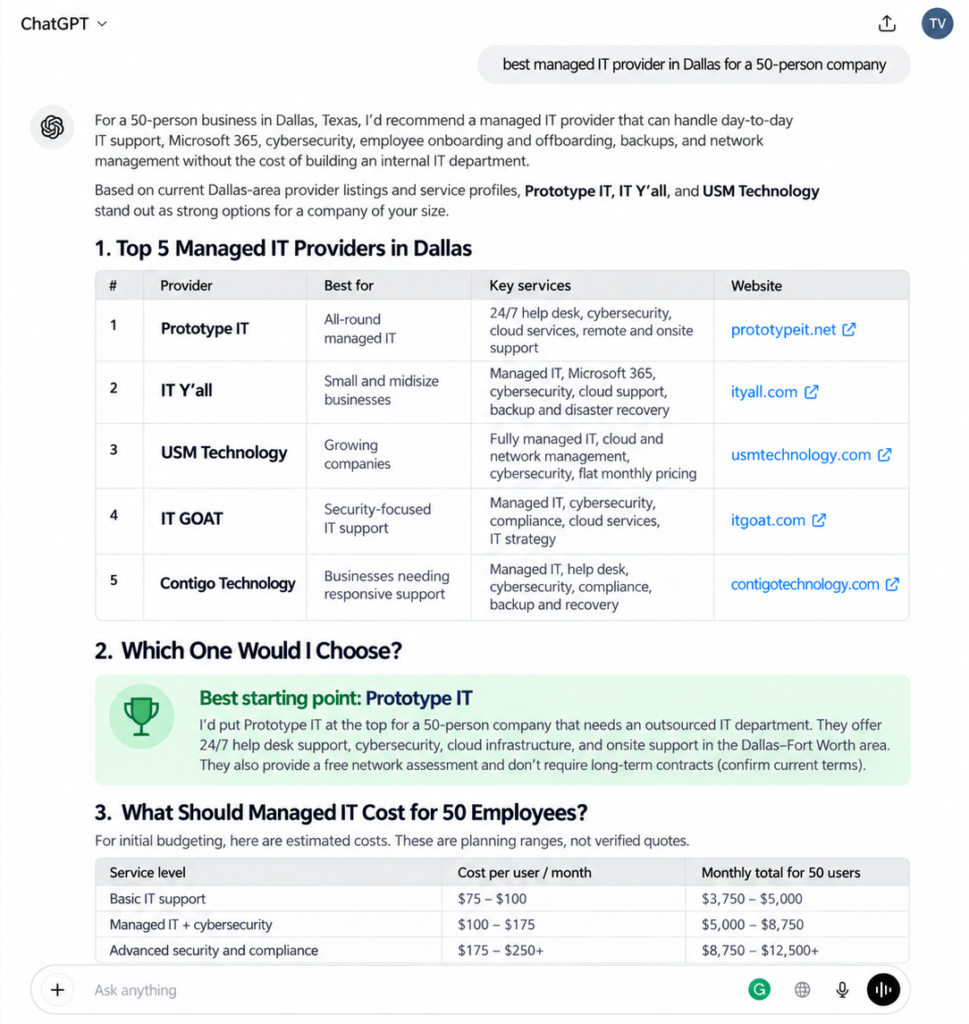
The cited sources are the most useful column in the log. They show you exactly which pages you need to be on, or need to beat.
Don’t want to do it by hand? Our free AI Visibility Report runs the buyer questions for your category across ChatGPT, Perplexity and Gemini and shows who gets named instead of you, and why.
How long does it take to show up in ChatGPT answers?
It depends on which fix you’re making. A robots.txt change applies in about 24 hours, according to OpenAI. New or rewritten pages can start showing up in search-based answers within a few weeks of being crawled. New reviews and list mentions take one to three months to build. Getting into the model’s training memory takes longest, because that only updates when a new model ships.
Anyone who guarantees a recommendation by a date is guessing. What you can control is the evidence: pages, proof, mentions and access.
Does this work differently for MSPs, software companies and industrial firms?
The signals are the same. Where the evidence lives is different.
- MSPs and IT services firms: buyers ask locally (“in Dallas”, “near me”) and by industry. Google reviews, city and industry service pages, and vendor partner directories carry a lot of weight. See our B2B Services work.
- B2B software: buyers ask for comparisons and alternatives. G2 and Capterra reviews, honest comparison pages and clear pricing pages matter most. More in [How B2B buyers use AI to shortlist software](LINK WHEN LIVE).
- Industrial and manufacturing: buyers ask about specs, tolerances and certifications. Turn PDF spec sheets into readable web pages, and keep distributor and directory listings accurate.
Frequently asked questions
No. OpenAI says ChatGPT's answers are chosen independently of advertising. What companies pay for is the work that makes them easy to find and verify: pages, reviews, mentions and technical fixes.
No. GPTBot is for model training. ChatGPT search uses OAI-SearchBot, and OpenAI treats the two settings separately, so you can opt out of training and stay visible in search answers.
It helps a model understand who you are and what you offer, which removes ambiguity. It won't get you named on its own. Clear page copy and third-party proof matter more.
Maybe a little, and it's cheap to add. No AI company has confirmed that it relies on llms.txt, so don't make it your strategy.
They matter more in some engines than others. Onely's research found Reddit was rarely cited by ChatGPT itself, but Reddit threads show up often in search results and in Google's AI answers. Genuine, named participation in the communities your buyers use is worth doing. Spam isn't, and it gets spotted fast.
Track referral traffic from chatgpt.com, perplexity.ai and gemini.google.com in GA4, add a free-text "How did you hear about us?" field to your forms, and ask on every first call. AI-sourced buyers often arrive already shortlisting you, so watch close rates as well as volume.