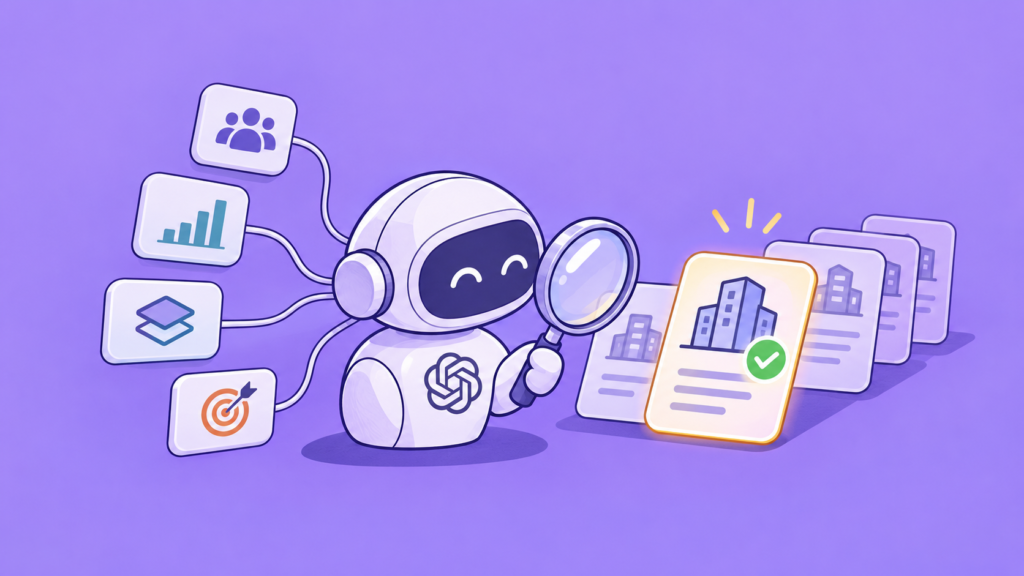
AEO for MSPs means getting your managed IT or IT services firm named when a buyer asks ChatGPT, Gemini, Copilot or Google’s AI Mode who they should hire. It’s built on the same base as SEO, but the AI picks from what other sites say about you, not only what your site says about itself.
For MSPs, the gap between Google and AI answers is wide. In an October 2026 test of five AI engines, 152 different MSPs came up across 12 buyer questions, and only 20% to 30% of them also showed up in Google’s regular results (Channel Dive). So ranking on Google doesn’t mean the AI will name you, and a firm that barely ranks can still get recommended.
Quick answer: how an MSP gets recommended by AI
- Build one page per service, per vertical and per city you actually serve, each answering the buyer’s question in the first two sentences.
- Publish real numbers: per-user pricing ranges, response times, client counts, certifications.
- Get listed and reviewed where AI engines look: Clutch, Google Business Profile, Bing Places, G2 and the “best MSPs in [city]” lists.
- Keep your company facts identical everywhere (name, address, services, headcount).
- Let AI crawlers in, add schema, and test 20 to 30 real buyer prompts every month.
The rest of this guide shows how to do each one, what the AI engines say about MSPs today, and what to fix first. If you want the general picture before the MSP specifics, start with how ChatGPT decides which B2B companies to recommend.
How are buyers using AI to pick an IT provider?
They’re using it to build the shortlist, then using Google and referrals to check it. The numbers that matter:
Buyer behavior
The shortlist now starts in ChatGPT
The last row is the one MSP owners should sit with. The searches that used to fill your contact form, like “managed IT pricing” and “co-managed IT cost,” are shrinking on Google. The questions didn’t go away. They moved into ChatGPT, and the answer now comes back as a short list of names.
It shows up in pipeline, too. Ntiva’s VP of Marketing told Channel Dive that leads from AI search are now “almost neck and neck” with Google leads. Ntiva is one of the most-recommended MSPs in the US, so that’s the top of the curve, not the average. But it tells you where this is going.
What this means for a 10 to 100 person MSP: the buyer who finds you through a referral will still ask ChatGPT about you before the first call. If the AI doesn’t know what you do, who you serve or where you are, you’ve lost ground before anyone picks up the phone.
Which MSPs do ChatGPT and Gemini actually recommend?
A small group of large, well-documented firms, and then a long tail of names that show up once. In October 2026, SourceRank asked ChatGPT, Gemini, Copilot, Google AI Mode and Google AI Overviews 12 MSP buyer questions, like “best managed IT provider for a 200-person US company” (Channel Dive). What came back:
- Dataprise was a top pick on all five engines. It tied with Ntiva on ChatGPT, AI Mode and AI Overviews, and with Corsica Technologies on Copilot.
- The rest of the top 10: Thrive, Integris, NexusTek, Synoptek, All Covered, Accenture and Net at Work.
- 152 different MSPs were named in total, and most of them only once. The AI is not loyal to anyone below the top tier yet. That’s the opening.
- Clutch was the most-cited source. Review sites and directories were the third biggest group of sources overall.
- MSPs that published their own “best MSPs” lists got cited, but not recommended. Zazz, Cortavo and CompassMSP made the top 12 sources. None of them made the top 12 firms.
That last point is worth a pause. Writing a listicle that ranks your competitors will get your page quoted. It won’t get your company picked. The engines seem to trust third-party sources for the recommendation itself.
Pricing questions work the same way. When Christopher Jan Benitez asked ChatGPT five co-managed IT pricing questions, it answered with about $85 per user per month and cited one directory report in four of the five answers. Every provider that ChatGPT or Google’s AI Overviews cited for pricing published specific prices on its own site (Benitez). If you don’t publish your price, the AI will quote someone else’s.
Run the test on your own firm
Open ChatGPT, Gemini, Copilot and Perplexity in a logged-out or private window and ask questions your buyers would ask. Swap in your city, vertical and size:
October 2026 study
Which MSPs AI engines recommend
ChatGPT, Gemini, Copilot, Google AI Mode and AI Overviews, asked 12 MSP buyer questions.
- DatapriseTop pick on all 5 engines
- Ntiva
- Corsica Technologies
- Thrive
- Integris
- NexusTek
- Synoptek
- All Covered
- Accenture
- Net at Work
The top 10 recommended firms, not in rank order after Dataprise. Dataprise tied with Ntiva on ChatGPT, AI Mode and AI Overviews, and with Corsica Technologies on Copilot. Study by SourceRank.
Run the test
8 prompts to test your MSP on
Use a private window in ChatGPT, Gemini, Copilot and Perplexity. Swap in your city, vertical and size.
| Buyer stage | Prompt to test |
|---|---|
| Shortlist | Best managed IT provider in [city] for a 50-person [law firm / dental group / manufacturer] |
| Shortlist | Who offers co-managed IT for a company with an in-house IT person in [state]? |
| Compliance | Which MSPs in [region] help with HIPAA for a multi-location medical practice? |
| Compliance | MSP that can get us ready for CMMC Level 2 |
| Price | How much does managed IT cost per user for a 40-person company? |
| Switching | Our MSP is slow to respond. How do we switch providers without downtime? |
| Vetting | Is [your company] a good MSP? What do clients say? |
| Vetting | [Your company] vs [competitor] for managed IT |
For each answer, log three things: whether you're named, how you're described, and which sites are cited.
Write down three things for each answer: whether you’re named, how you’re described, and which sites the answer cites. The cited sites are your to-do list.
Why doesn’t ChatGPT recommend my MSP?
Usually because there’s nothing specific enough about you to repeat. AI engines recommend firms they can describe in one confident sentence: who you serve, where, what you do, and proof it works. Most MSP websites don’t give them that sentence.
In October 2026 we checked the homepages of 11 US MSPs that were growing or hiring. These are healthy businesses, not struggling ones. Here’s what we found:
Pathloft review, October 2026
What we found on 11 growing MSPs' homepages
- Broken or placeholder elements
buttons to "#", raw shortcode, cut-off text, stale booking links6 of 11 - Out-of-date signals
2018 photos, 2021 metadata, old award badges, retired services5 of 11 - No named client with a company attached
anonymous, missing or hidden testimonials5 of 11 - No industry or city focus
nothing on the homepage says who or where they serve3 of 11
Across 70 US MSPs, 46% had no pricing content at all (Benitez, Oct 2026).
The industry-wide numbers match. In a study of 70 US managed IT providers, 46% had no pricing content at all, and only 1 of 40 co-managed IT pages stated its own price (Benitez, Oct 2026).
Here’s why each one costs you with AI:
- Vague positioning. “Your trusted IT partner” gives an AI nothing to match against “MSP for a 60-person accounting firm in Denver.” A page that says it gets matched.
- Anonymous proof. “Great service! J.S.” can’t be repeated as a reason to pick you. “Cut ticket response time from 9 hours to 40 minutes for a 120-person law firm” can.
- No prices. When you stay quiet, the AI quotes a directory’s number, and the directory gets the citation.
- Stale and broken pages. These hurt crawling and trust, and an AI summarizing your site may repeat outdated services as current.
- Inconsistent facts. One site in our sample used two different company names. If your name, address or headcount differ between your site, LinkedIn and Clutch, it’s harder for the AI to tell they all describe the same company.
How do you get your MSP recommended by AI? The 8-step playbook
Do these in order. The first three are cheap and fast, and the later ones only work once they’re done.
1. Make your company facts match everywhere
Pick one company name, one address format, one list of services and one headcount, and use them on your site, LinkedIn, Google Business Profile, Bing Places, Clutch, G2 and any MSP directory you’re on. Add Organization and LocalBusiness schema to your site, and keep it matching what’s visible on the page. Google says plainly that no special AI markup is needed, but structured data that matches your visible text is on its list of best practices (Google Search Central).
2. Build pages an AI can match to a real question
Buyers don’t ask for “managed IT services.” They ask for an MSP for a 40-person CPA firm in Phoenix that knows QuickBooks hosting and IRS Pub 4557. You need pages that match that level of detail. Start with your top 3 verticals and your top 2 metros, and give each page:
Page blueprint
What every MSP vertical or city page needs
| Section | What to put in it |
|---|---|
| First two sentences | Who it's for and what you do for them, in plain words |
| Who it's for | Industry, company size, locations you cover on-site vs remote |
| What's included | Helpdesk hours, response and resolution times, security stack, backup, vCIO |
| Price range | Per user or per device, and what changes the price |
| Compliance | HIPAA, PCI, CMMC, SOC 2 or FTC Safeguards, only the ones you actually support |
| Proof | One named case study or a result with company type and size, plus a review |
| FAQs | 4 to 6 questions that buyer actually asks, answered in 2 to 3 sentences each |
A page for “IT support for law firms in Dallas” with real detail gives Google and the AI engines far more to work with than a general “Industries we serve” page.
3. Publish your pricing, even as a range
The MSPs that AI cites on pricing are the ones that publish it. Published per-user entry prices for managed IT run about $45 to $120 a month, with a median of $99.50 (Benitez). You don’t have to show your exact quote. “Most 25 to 75 user clients pay $110 to $165 per user per month, depending on compliance and on-site needs” is specific enough to be quoted and still leaves room to scope.
4. Turn your proof into specifics
Rewrite testimonials and case studies so they carry a company type, a size and a number. “Moved a 3-office dental group to a single Microsoft 365 tenant in 6 weeks with no lost patient records” is a sentence an AI can lift. Get permission to name clients where you can. Where you can’t, “a 90-person engineering firm in Ohio” is still far better than “a client.”
5. Get reviewed where the engines look
Clutch was the single most-cited source in the MSP study above. Ask your 10 happiest clients for a Clutch review this quarter, and keep Google Business Profile and Bing Places reviews coming in every month. Then go after mentions on sites you don’t own: local business journal lists, chamber of commerce directories, vendor partner pages (Microsoft, SentinelOne, Datto), and “best MSPs in [city]” roundups written by someone else. In a study of about 75,000 brands in Google’s AI Overviews, branded web mentions correlated far more with visibility (0.664) than backlinks did (0.218) (Ahrefs).
6. Answer the questions buyers ask before they call
The questions that bring MSP buyers to AI are practical: How do we switch MSPs without downtime? What’s the difference between co-managed and fully managed IT? How long does onboarding take? What should a managed IT contract include? Write one honest, specific answer to each, on your site, with your own numbers. These pages get cited because they’re the most useful thing on the topic, not because of keywords.
7. Let the AI crawlers in
Check your robots.txt and your CDN or firewall bot settings. Make sure Googlebot, Bingbot and OAI-SearchBot (the crawler behind ChatGPT search) can reach your site. GPTBot only collects training data, so blocking it won’t hide you from ChatGPT search (OpenAI). Then verify your site in Google Search Console and Bing Webmaster Tools.
8. Put a person behind the brand
MSPs are bought on trust, and AI engines quote people. Give your founder or vCIO a full bio page, post on LinkedIn about what you’re seeing in the field, and say yes to podcast and trade press requests. The same Channel Dive report notes that some MSPs are now spending more on PR because it may help them get into the data AI models learn from. Then refresh your top pages every quarter, with the date visible.
How does local AI search work for MSPs?
Most MSPs sell inside one or two metros, so “near me” and “in [city]” questions are where you win or lose. The catch is that each engine pulls local data from a different place, so a perfect Google profile only covers part of it.
Local AI search
Where each AI engine gets local MSP data
| Engine | Where local data comes from | What to do |
|---|---|---|
| Google AI Overviews and AI Mode | Google's index and your Google Business Profile (Google) | Fill every field, pick the right primary category, post monthly, answer every review |
| Microsoft Copilot | Bing Maps, so Google reviews don't help there (Channel Dive) | Claim Bing Places, import from Google, collect a few reviews there too |
| ChatGPT | Not confirmed by OpenAI. Researchers point to Bing data and review sites (Whitespark) | Cover Bing Places, Clutch and Facebook, with identical facts on each |
| Perplexity | The live web, with sources shown | Be on the pages it cites for your city: local lists, directories, news |
Three common local mistakes:
- City pages with only the city name swapped. Google treats near-identical location pages as doorway pages. Only build a metro page where you have clients, and put real local detail on it: on-site response time, local clients, the industries big in that city.
- Hiding that you’re remote. If you serve clients in five states from one office, say so, and say what on-site support looks like in each. AI answers repeat what you state clearly.
- Wrong service area. Check that your Google and Bing listings show the area you cover. A city missing from your listing is a city you’re less likely to be recommended in.
How should MSPs serving healthcare, legal, finance and defense handle AEO?
Compliance verticals are often the fastest place for an MSP to start showing up in AI answers. The buyer’s question is narrow, the stakes are high, and a page that answers it directly stands out. Name the rule, say what you do about it, and show you’ve done it before.
Compliance verticals
What regulated buyers ask AI, and what your page must say
| Vertical | What the buyer asks AI | What your page needs to say |
|---|---|---|
| Healthcare | "MSP that will sign a BAA and handle HIPAA for a 4-location clinic" | That you sign a Business Associate Agreement. HHS treats cloud providers that handle patient data as business associates who must sign one (HHS). Then your EHR experience and how you handle backups and breach response |
| Defense contractors | "Who can get us ready for CMMC Level 2?" | Which CMMC levels you support, whether you're a Registered Practitioner Organization or partner with one, and how you scope CUI. CMMC started appearing in DoD contracts on November 10, 2025, with a phased rollout through 2028 (Venable) |
| Accounting and tax | "IT provider for a CPA firm, FTC Safeguards Rule" | Your written information security plan help, MFA rollout, and tax software hosting experience. Link the IRS guidance your clients follow (IRS Publication 4557) |
| Legal | "Managed IT for a 30-attorney firm, document management" | The practice management and document systems you support, how you protect client confidentiality, and after-hours support during trial prep |
Two rules for compliance pages:
- Only claim what you can prove. AI answers repeat what you say, and a buyer in a regulated industry will check. “HIPAA certified” is a red flag to anyone who knows there’s no such thing. “We sign BAAs and have supported 14 medical practices since 2019” is the kind of line that gets repeated and believed.
- Have a human with the credentials review it. Get your vCISO or compliance lead to sign off on every claim, and put their name on the page.
What does a 30-day AEO plan look like for a 10 to 100 person MSP?
One person can run this in about 4 to 6 hours a week, with a developer for a few hours in week 1. It won’t make you the top answer in a month. It will fix what’s keeping you out of the answer and give you a baseline to measure from.
30-day plan
AEO for a 10 to 100 person MSP
About 4 to 6 hours a week for one person, plus a developer for a few hours in week 1.
Baseline and plumbing
- Run 20 to 30 buyer prompts across ChatGPT, Gemini, Copilot, Perplexity and AI Mode. Log who's named and what's cited
- Check robots.txt and CDN bot settings for Googlebot, Bingbot and OAI-SearchBot
- Fix broken links, placeholder buttons, raw shortcode and outdated services
- Verify your site in Google Search Console and Bing Webmaster Tools
Facts and listings
- Write your one-paragraph company description and use it everywhere
- Match name, address, services and service area on Google, Bing Places, LinkedIn, Clutch and G2
- Add Organization and LocalBusiness schema that matches your page
- Ask your 10 best clients for a Clutch or Google review
Pages that get you matched
- Rewrite your homepage hero: who you serve and where, in one sentence
- Publish one vertical page for your strongest industry
- Publish a pricing page with real ranges
- Turn your best client story into a case study with a number
Answers and outreach
- Publish two buyer-question pages, like switching MSPs and co-managed vs fully managed
- Pitch two lists the AI cited in week 1
- Ask your top vendor partners to list you in their directory
- Re-run the week 1 prompts and note what changed
Want the general version of this plan, for any B2B firm? It’s in our ChatGPT recommendations guide.
How do you measure AEO for an MSP?
Track five numbers once a month, from the same prompts on the same engines, so the trend means something. AI answers change from run to run, so one good screenshot proves nothing.
Measurement
5 numbers to track every month
| Metric | How to get it | A realistic first-year goal |
|---|---|---|
| Mention rate | Prompts where you're named, divided by prompts run | From near zero to 1 in 4 of your local and vertical prompts |
| Share of voice | Your mentions vs your 3 closest local competitors on the same prompts | Named as often as the strongest of them |
| Accuracy | Does the AI describe your services, location and verticals correctly? | No wrong facts on any engine |
| Cited sources | Which sites the answers link to when they name firms in your market | You're listed on most of them |
| AI-referred leads | Referrals from chatgpt.com, perplexity.ai, gemini.google.com and copilot.microsoft.com in GA4, plus an "AI assistant" option on your "How did you hear about us?" field | Counted every month, with a source on every new deal |
The last row is the one your CFO cares about, and it’s undercounted everywhere, because many buyers read the AI’s answer and then Google your name. Ask every new client how they found you, and write it down.
You can track the prompts by hand in a spreadsheet, or use a tool. Entry plans run $29 to $199 a month, and some only cover one engine. The full price breakdown is in How much does AEO cost?
What does AEO cost an MSP, and should you do it yourself?
A one-time AEO audit runs about $1,000 to $5,000. An ongoing program for a 20 to 200 person B2B company usually lands between $2,500 and $8,000 a month, depending on how many verticals and metros you need covered. We broke down every option, including tools and freelancers, in How much does AEO cost? Real price ranges for B2B.
The math for an MSP is simple. One new 40-user client at $125 per user is $60,000 a year in recurring revenue, and most MSP clients stay for years. If AEO brings in one extra client a year, it has probably paid for itself. Plug in your own numbers before you sign anything.
Do it yourself if you have a marketer with 5 or more hours a week, your site is in decent shape, and you can get clients to give reviews. The 30-day plan above is the place to start.
Get help if you need new vertical and city pages written by someone who understands MSP buyers, you’re trying to break into a compliance vertical, or nobody on your team has time to run the monthly prompt tests and outreach.
Mistakes that cost MSPs AI visibility
- Writing “best MSPs in [city]” lists that rank yourself first. They get cited as sources, but in the Channel Dive study none of the MSPs behind those lists made the top 12 recommended firms. The engines don’t seem to reward it.
- Buying or gating reviews. The FTC’s rule on fake reviews applies to you, and a burst of five-star reviews in one week looks exactly like what it is.
- Claiming certifications that don’t exist. There’s no such thing as “HIPAA certified.” Say what you actually do.
- Blocking the wrong bots. Blocking OAI-SearchBot or Bingbot, often by accident through a CDN setting, hides you from ChatGPT search and Copilot.
- Paying for guaranteed AI rankings. Nobody controls what ChatGPT says. Ntiva’s VP of Marketing put it bluntly: the variability makes AEO “an opportunity for people who are selling snake oil” (Channel Dive).
Frequently asked questions
AEO (answer engine optimization) for MSPs is the work of getting a managed IT or IT services firm named in answers from ChatGPT, Gemini, Copilot, Perplexity and Google's AI results. It covers your website, your listings and reviews, and what other sites say about you. Some agencies call the same work GEO (generative engine optimization) or AI search and discoverability.
It builds on SEO but isn't the same thing. SEO gets your pages ranked. AEO gets your company named, which depends heavily on reviews, directories and lists you don't own. In the October 2026 MSP study, only 20% to 30% of the firms AI recommended also showed up in Google's results.
On broad national prompts, rarely. On "MSP for a 30-person law firm in Tampa," absolutely, because the big firms don't have a page for that. The same study found 152 different MSPs across just 12 prompts, so the field is wide open below the top tier.
Technical fixes and listing updates can be picked up within weeks. Mentions from new reviews, lists and press take longer. Crackle PR's 2026 benchmark of B2B tech brands put the median lag from a press placement to an AI citation at 68 days (MarketScale). Plan on 3 to 6 months before judging results.
It helps with Google's own AI results. For ChatGPT, it's less clear, and OpenAI hasn't said which local data it uses. Copilot uses Bing data, so keep your Bing Places listing as complete as your Google one.
The one your buyers use, so ask new clients. Test at least ChatGPT, Gemini, Copilot, Perplexity and Google AI Mode, because they pull from different sources and often name different firms for the same question.